
Creative Projects
UNSCORED — Exploring Identity Through Music & Portraiture
UNSCORED is a personal portrait project. It focuses on young, emerging musicians at a pivotal stage in their creative journeys. Through intimate and thoughtfully crafted portraits, the project explores identity, self-expression, and individuality. Furthermore, by removing the context of the score and the stage, UNSCORED offers a space where musicians are seen not just as performers, but as people. As a result, it captures quiet moments, confidence, vulnerability, and the evolving sense of self that defines who they are becoming.
Personal Work Beyond Performance
My creative projects exist outside the boundaries of traditional commissions. Consequently, they allow space to experiment, reflect, and tell deeper stories. These works focus on people rather than performance. In addition, they use portrait photography to explore identity, emotion, and personal narrative. Each project is therefore an opportunity to slow down, look closer, and create images that feel honest, thoughtful, and enduring.


Thomas Shorthouse, composer.
Location: Tate Modern
Thomas’s music explores the relationship between structure, space, and what remains after sound has passed. He is drawn to environments that are partly controlled and partly unpredictable. He treats composition like shaping concrete — setting the form, then allowing organic imperfections to emerge.
In works such as Glitter on the Pavement, he reflects on industrial spaces and the emotional aftermath of gatherings. These include warehouses after raves and celebrations that have dissolved, leaving only traces behind. Acoustic instruments push outward, as if pressing against the walls of an imagined space. Electronics respond in return, creating a dialogue between sound and environment. For Thomas, music is not only heard but spatially felt. It seeps from corners, rubs against surfaces, and reveals the presence of something unseen.
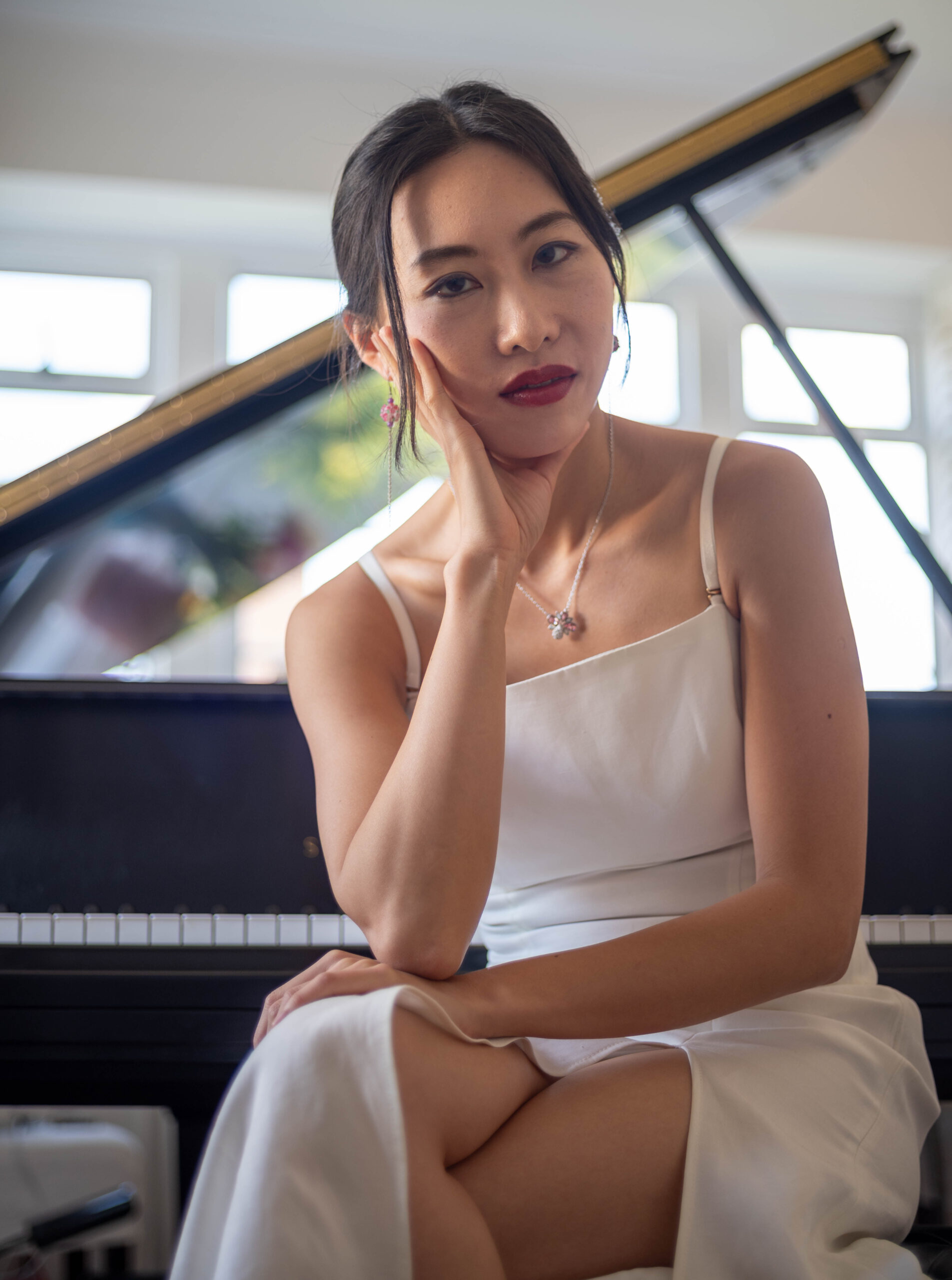
Peng Lin, pianist.
Location: Her studio
Peng grew up on Gulangyu, a small island off the southeast coast of China, nicknamed Piano Island. Since then, she has found herself continually drawn to island cities whose cultural life feels vibrant and alive. As a pianist, her relationship with music moves fluidly between classical repertoire and improvisation. The score is a starting point — a trace of the composer as a human being. However, much of the music lives beyond what is written. Through imagination, listening, and lived experience, she seeks what cannot be notated — the silences, the spaces, the unspoken emotional life of a work. Her studio is filled with colour, objects, and memories gathered over time. It reflects a personal, safe space that connects past and present and allows her to play freely. For Peng Lin, Unscored is where music truly comes alive — in what is left unsaid, unheard, and still waiting to be discovered.

Rishi Mirchandani, pianist.
Location: The round pond, Hyde Park.
After hours of practice, Rishi is drawn to a quiet pond in Hyde Park. It is a place not for answers, but for noticing. Here, thinking loosens its grip. Attention shifts to feathers on birds, the subtle colours of the pavement, and small details usually lost in his constant mental buzz. What he calls meditative is less about escape and more about awareness. It is a gentle returning to the senses. In this pause, away from effort and analysis, he finds space to simply be. It is often here, in stillness, that clarity quietly begins to surface.
The Jasmine Quartet.
Location: The Muddy Puddle
The Jasmine Quartet came together through a shared desire to make music that feels urgent and inclusive. They have a particular commitment to repertoire by women and other underrepresented composers. Their name began as an inside joke rooted in shared Asian heritage. However, it has grown into something more symbolic — a marker of identity, connection, and care. Much of their work centres on music that is still in the process of becoming. These are pieces not yet fully written, heard, or defined. They collaborate closely with composers and value story, silence, and the sense of discovery that comes with new music. Furthermore, they perform in spaces across London that don’t traditionally host string quartets. Their path has been deliberately non-traditional, shaped by curiosity rather than convention. For the Jasmine Quartet, being unscored is about seeking what hasn’t happened yet — and allowing space for something new to emerge.

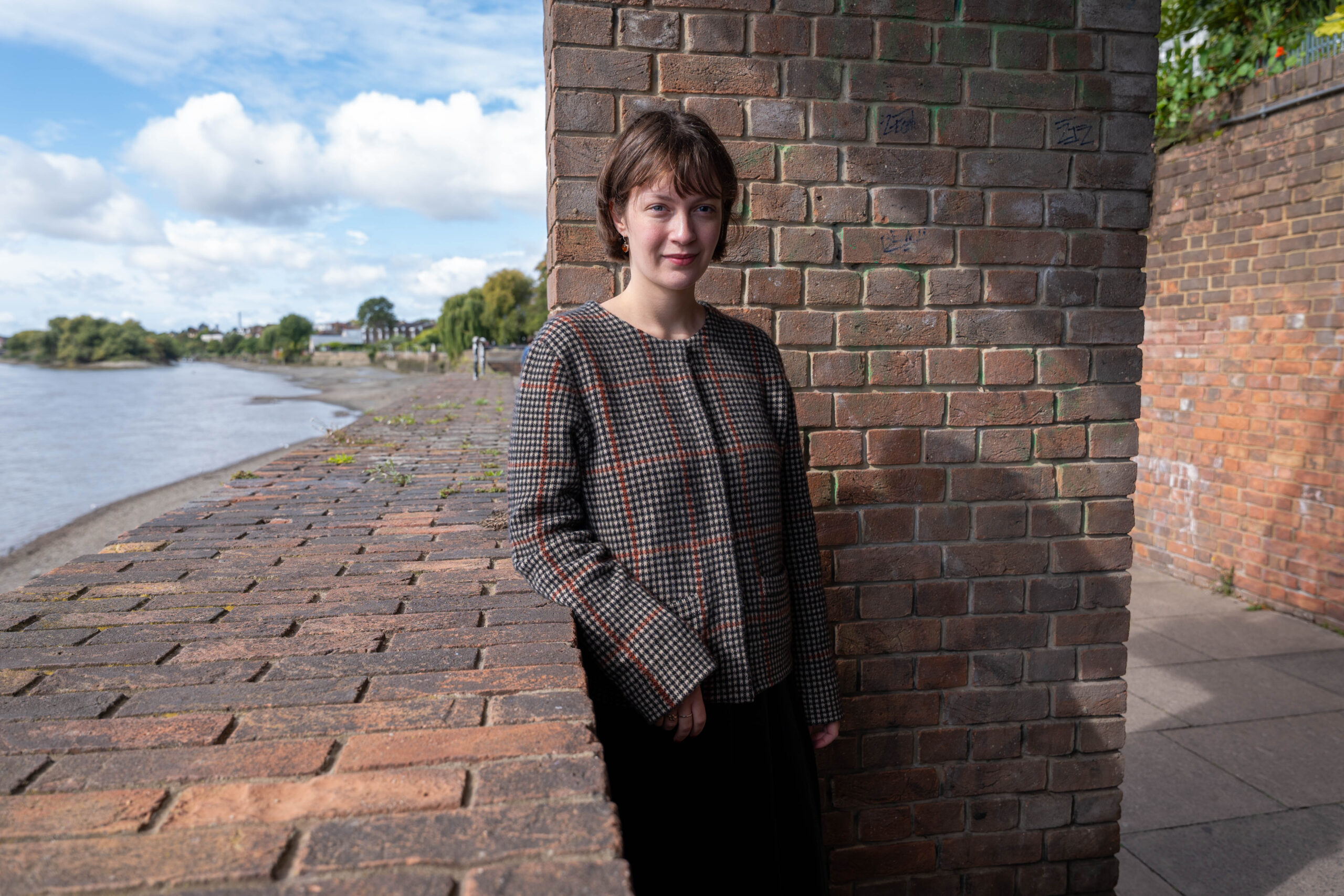
Molly Frances Arnuk, composer.
Location: The Thames Path, Ravenscourt Park
Molly is drawn to the subtle unfolding of musical lines and textures. She crafts pieces that seem almost still until, suddenly, something remarkable emerges. Her compositions are like three-dimensional tapestries. Voices and timbres weave together with the delicacy and complexity of threads in a textile. Recently, she has been transforming visual patterns into musical material. These patterns come from knitting and weaving designs, layered to create rich, shifting textures. Her experience as a violist gives her a natural affinity for strings. She uses them to shape colour, depth, and the tactile quality of sound. She was drawn to Unscored for its focus on the creative process. It offered an invitation to explore how composers nurture ideas and reveal the hidden work behind the music we hear.
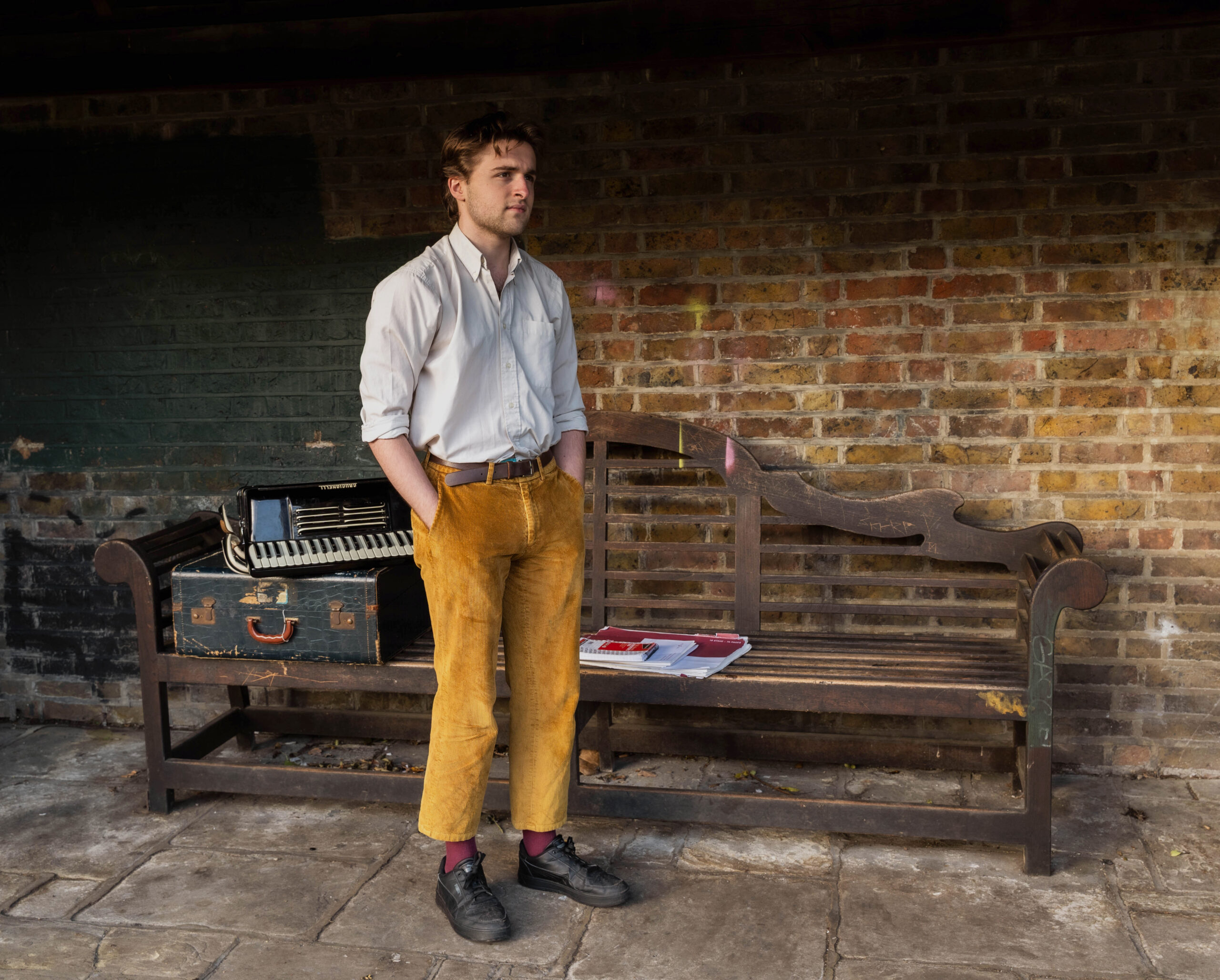
Robert Baird, composer.
Location: The walled garden, Ravenscourt Park.
Robert is a composer from Glasgow. His work is shaped by intuition, collaboration, and a strong sense of place. Much of his creative life is rooted in spaces of quiet reflection — places where memory, landscape, and sound intersect. While living in London, he returns to a bench near Ravenscourt Park. It mirrors one dedicated to his mother in Glasgow, becoming a personal site of stillness and focus. Alongside writing for a wide range of ensembles, he has recently returned to playing the accordion. This reconnects him with music-making as something physical, communal, and instinctive. His portrait for Unscored reflects the unseen layers behind his work — the pauses, the private spaces, and the music that exists beyond what is written on the page.
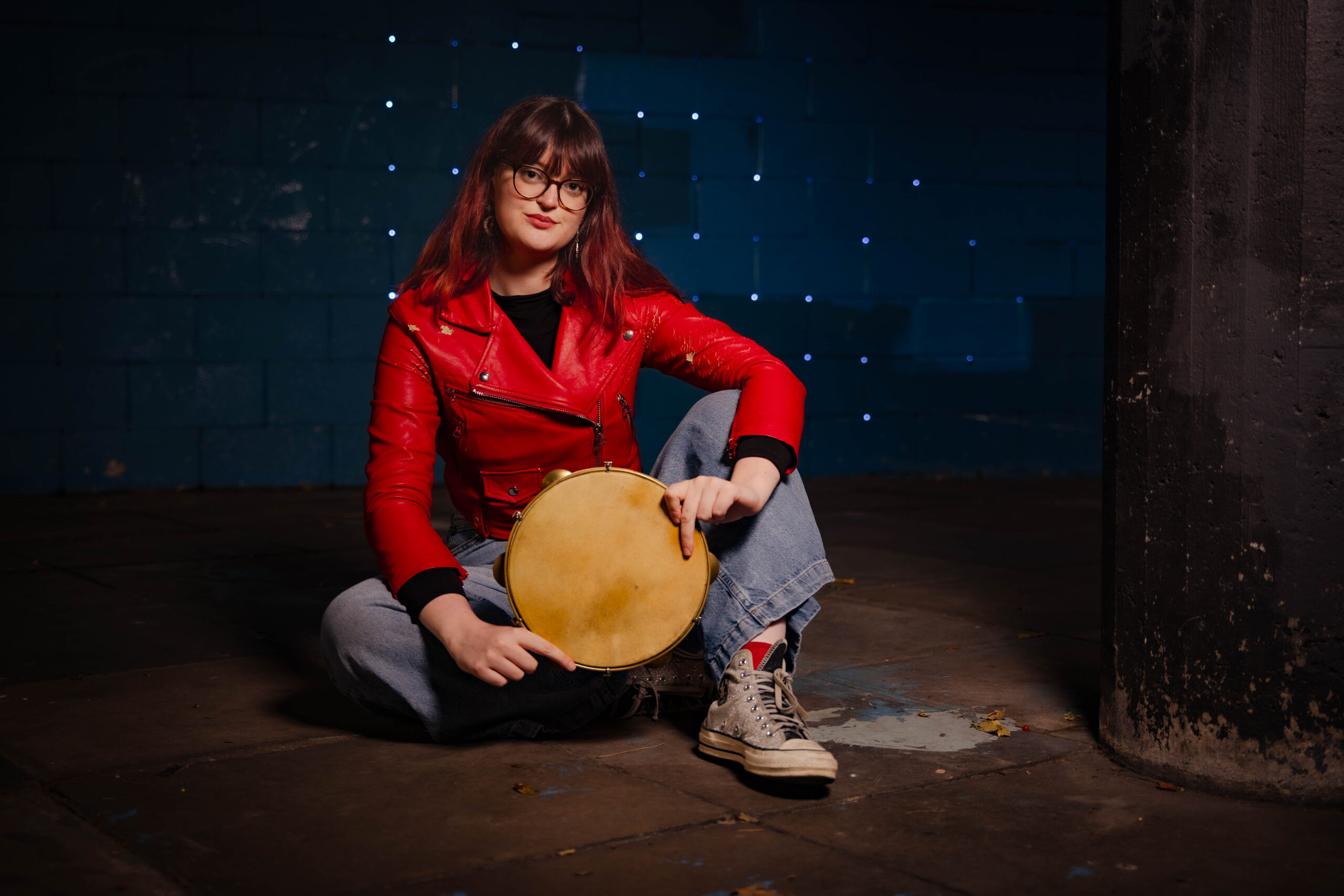
Sophie Stevenson, percussion player
Location: The Waterloo Underpass
Sophie grew up immersed in music. Her path as a percussionist emerged almost by chance. Her curiosity has led her through piano, trombone, singing, and a wide variety of instruments. As a result, percussion became her home for its versatility and scope. She has a particular love for Brazilian music. She is drawn to its rhythms, history, and improvisational spirit. This reflects her wider approach to exploring and connecting different musical styles. As a multi-instrumentalist, she values adaptability and creative freedom. She expresses ideas through whichever instrument best suits the moment. Unscored resonates as a space of improvisation and discovery. Similarly, the urban energy of the Waterloo Underpass mirrors this — a bold, dynamic stage for presence, experimentation, and self-expression.
Ozgur Kaya, cellist and composer
Location: South Bermondsey under the railway
Ozgur’s musical identity is shaped by curiosity, coincidence, and the freedom to move between worlds. He discovered music through the internet rather than the concert hall. His path into classical music — and the cello — was almost accidental. Intuition guided him rather than tradition, and a supportive environment allowed him to wander and discover at his own pace.
Alongside classical training, composition, early music, and electronic music sit at the centre of his practice. These reflect a refusal to accept rigid boundaries between genres that feel increasingly artificial in the digital age. For Ozgur, Unscored speaks to potential rather than absence — music not yet fixed, porous, and alive to context.
That idea finds a natural home beneath the railway arches of South Bermondsey. The raw, industrial space echoes the collective, informal spirit of underground electronic culture. Furthermore, it connects to earlier musical traditions. Removed from the formality of the concert hall, the location allows past and present to coexist. Acoustic and electronic, structure and improvisation sit side by side. Consequently, it mirrors Ozgur’s search for a musical language that feels honest, inclusive, and uncontained.
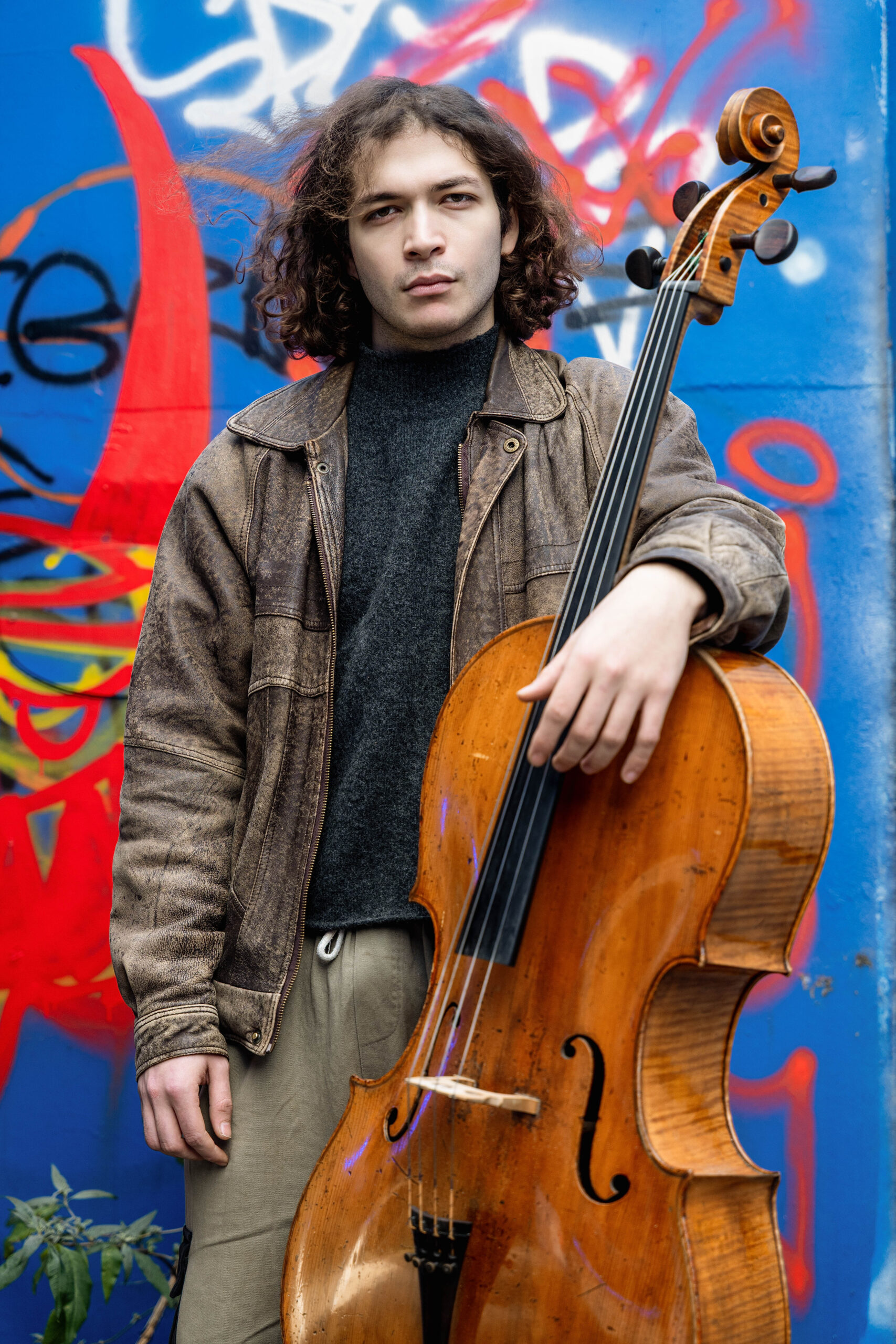

Knox Oakey, conductor.
Location: Little Venice
Born into a musical household, Knox’s earliest memories are rooted in sound. He recalls sitting beneath the piano as his mother taught, absorbing music before he consciously understood it. His formative years unfolded through piano study under her guidance. Later, mentors and intensive training in the United States deepened his practice. He travelled to New York for lessons and festivals before eventually leaving home to pursue conservatoire studies.
Drawn by a desire to expand beyond national boundaries, he chose to study at the Royal College of Music in London. There, he immersed himself in a broader artistic tradition shaped by place and history. While his foundation is as a pianist, his creative path naturally expanded into conducting. This shift moved him from solitary practice to collaborative leadership.
Through founding his own ensemble, Innova Orchestra, he created the platform he felt necessary at this stage of his development. It became a space for exploration, collective voice, and artistic risk. The portrait is set in Little Venice, a place near his home that he visits for its quiet, reflective quality. He often walks along the canals to think and internalise his work.
Surrounded by water and reflection, his practice moves between score study, memory, and embodied interpretation. For Knox, therefore, Unscored speaks to both the internalisation of music beyond the page and the possibilities of freedom — improvisation, experimentation, and reimagining what classical music can become.
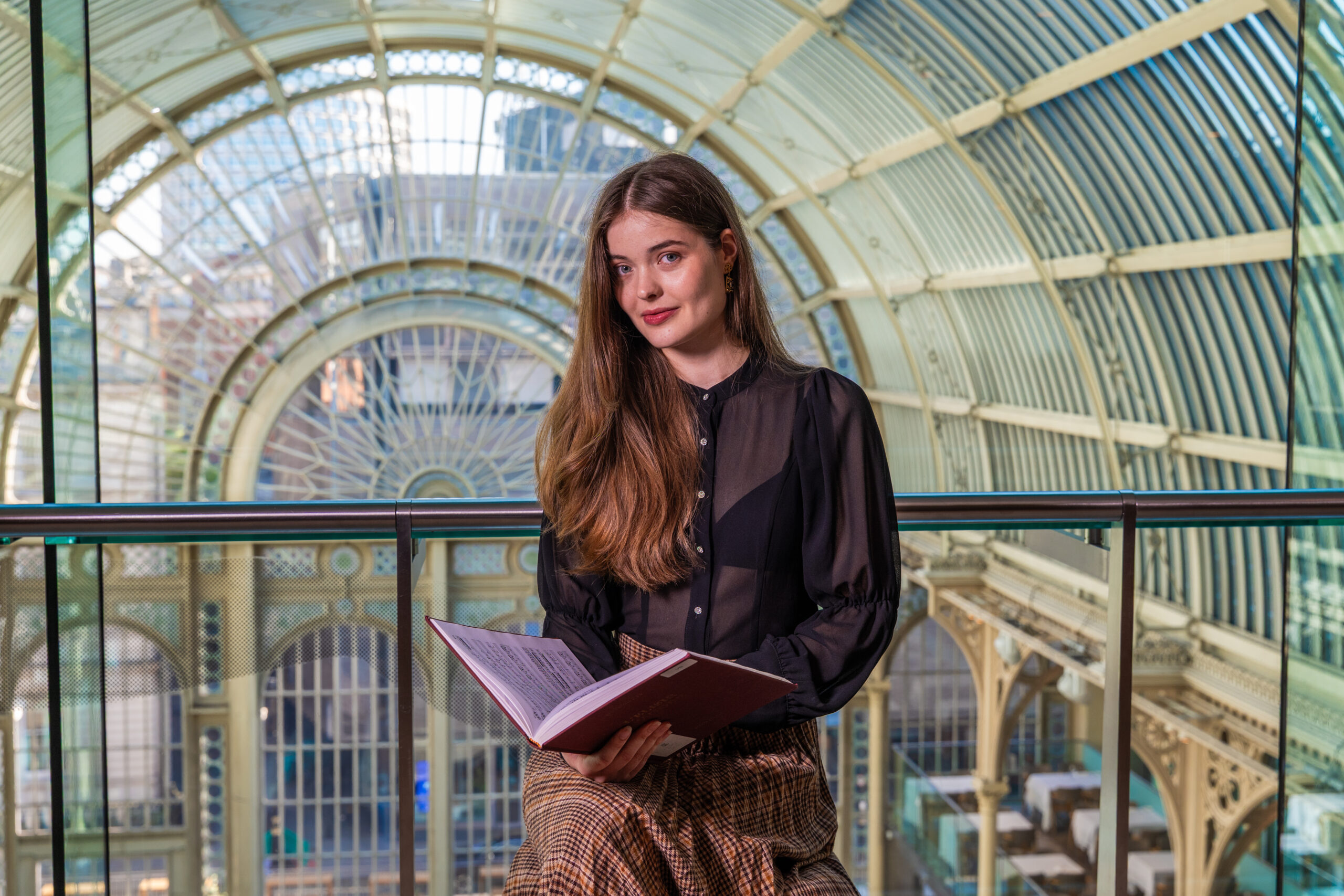
Josephine Shaw, soprano.
Location: The Royal Ballet and Opera
Josephine Shaw describes singing as something that has always been part of her life. As a child, she was constantly making sounds, and although she was shy, music gave her a way to express herself and gradually build confidence. Growing up in a home filled with music—from her mother’s love of jazz to an early fascination with musical theatre after seeing Wicked—she discovered opera through an unexpected opportunity to perform in the children’s chorus of La Bohème at the Royal Opera House. Standing on that stage and hearing Puccini’s music live was the moment she realised this was the path she wanted to follow.
Having now completed her studies at the Royal College of Music, Josephine is embarking on the next stage of her training with a Master’s degree at the Royal Academy of Music. She is acutely aware that opera is a long apprenticeship, requiring years of technical, musical and personal development, but she embraces the process with curiosity and determination.
For Josephine, Unscored reflects the quieter spaces around performance: the preparation, the humanity and the everyday life behind the finished result. She sees the project as a way of peeling back the curtain on classical music and revealing the person behind the voice. Her journey continues, guided by a desire to connect with audiences through stories that feel honest, human and emotionally true.
Let’s Create Lasting Images Together
If you’re interested in collaborating on creative projects, I’d love to connect. My work reflects a deep commitment to using photography as a tool for storytelling, exploration, and self-expression. Let’s create thoughtful, meaningful images that go beyond the surface—one project at a time.